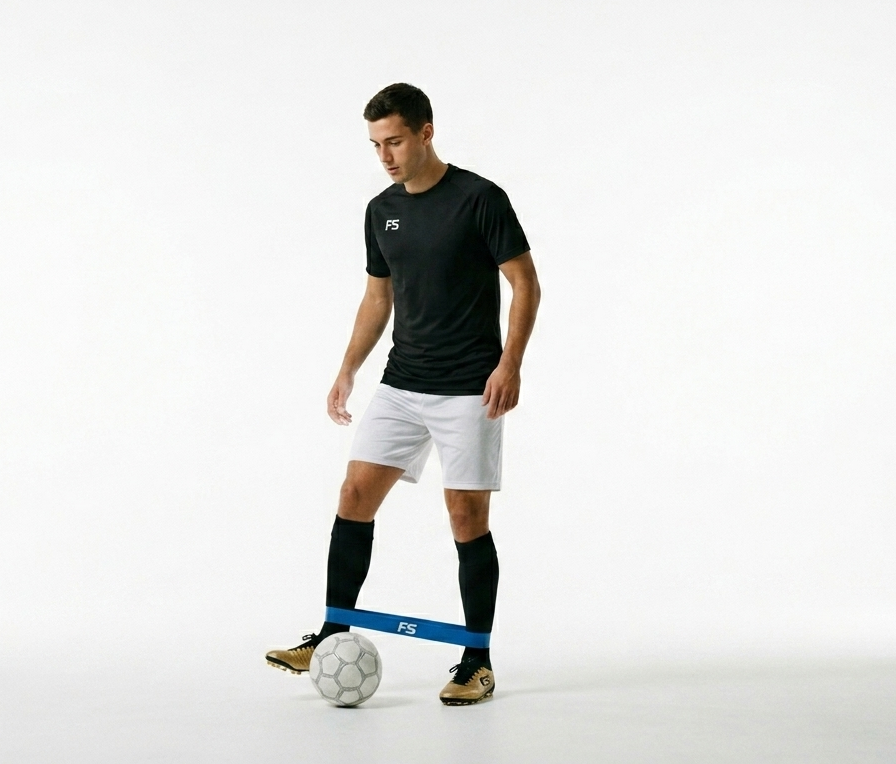

Many footballers invest 200, 250, or even over 300 Euros in high-quality football boots. They spend hours comparing models, testing fits, and analyzing the latest technologies. Yet, one crucial factor is often overlooked: socks.
However, football boots and socks form a unit. Even the best boot cannot unleash its full potential if the foot slips inside, pressure points develop, or stability is lacking. This is precisely where modern football socks come into play.
Why football socks are more than just regular football socks
Normal sports socks were not originally designed specifically for the demands of football. During a game, immense forces act on the feet and ankles during sprints, changes of direction, tackles, and shots.
Modern football socks were developed to support precisely these stresses. They improve grip in the boot, increase stability, and ensure that the foot's movements are transferred to the football boot as directly as possible.
The goal is simple: more control, more comfort, and a more secure playing feel.
Grip studs – the heart of modern football socks
The most striking feature of high-quality football socks are the so-called grip studs on the sole and often also in the heel area.
These special silicone or rubber elements increase the friction between the sock and the football boot. This prevents the foot from sliding back and forth inside the boot during fast movements.
The benefits are immediately noticeable:
- more stability during changes of direction
- better grip during sprints
- less friction in the boot
- lower risk of blistering
- more direct feel for explosive movements
Especially with modern football boots with smooth insoles, grip studs can make a significant difference. Instead of the foot slipping inside the boot before the movement is executed, power transfer is more immediate and controlled.
Material thickness determines ball feel
Another important factor is the material thickness of the sock.
Many players believe that a thick sock would automatically provide more comfort. In football, however, the opposite can be true.
Materials that are too thick often lead to:
- impaired ball feel
- a tighter boot
- pressure points developing
- the fit being distorted
High-quality football socks therefore rely on a targeted combination of thin and reinforced areas.
The top of the foot usually remains thin and flexible to maintain ball feel. At the same time, particularly stressed areas such as the heel and forefoot are lightly padded to increase comfort and durability.
The result is a sock that offers protection without compromising the important ball feel.
Stability around the ankle joint
Football is characterized by quick stops, abrupt changes of direction, and tight movements in confined spaces.
The ankle joint plays a central role in this.
Many football socks therefore feature special compression zones in the midfoot area and around the ankle joint. These ensure a firm fit and support the natural stability of the foot.
Important: A sock does not replace a bandage and cannot prevent injuries. However, it can help the foot sit more securely in the boot and movements to be executed more controlled.
Players who frequently play on artificial turf or hard surfaces often report a more stable and secure running feel.
Why compression can help reduce cramps
Another feature of modern football socks is the compression cut.
Due to the targeted pressure on certain muscle groups, the sock fits snugly on the foot and calf. This creates several advantages:
- less slipping of the sock
- improved muscle support
- comfortable fit throughout the game
- reduced muscle vibrations
Many players find this to be relieving and report a fresher feeling throughout the game.
However, it is important to understand that cramps can have different causes – for example, dehydration, overexertion, or lack of fitness. Football socks are therefore not a miracle cure for cramps, but their firm and supportive fit can contribute to a more comfortable wearing experience.
Double seams for more durability and comfort
In football, enormous stresses are placed on the foot area.
Especially during sprinting, braking, and shooting, strong tensile forces are exerted on the material. That's why high-quality football socks rely on reinforced or double seams in heavily stressed areas.
These ensure:
- longer durability
- higher shape retention
- lower risk of material wear
- more comfort under intense strain
Especially in the forefoot and heel area, clean workmanship makes a long-term difference.
While simple sports socks often show significant signs of wear after just a few months, high-quality football socks remain dimensionally stable and functional even with regular use.
The great contradiction of many footballers
It is astonishing how much attention footballers pay to their boots – and how little to their choice of socks.
Many players invest several hundred Euros in modern top models, but wear simple sports socks underneath, which were originally developed for everyday use or the gym.
Yet, it is precisely at this point that the weakest link in the entire equipment often arises.
A high-quality football boot is designed to provide maximum control, stability, and power transfer. However, if the foot slips inside the boot, many of these benefits cannot be fully utilized.
Therefore, the sock should not be regarded as an accessory, but as an integral part of the overall system comprising the foot, sock, and football boot.
The most important tip: Football boots should not be bought too big
Even the best football sock cannot compensate for a poorly fitting football boot.
Many players deliberately buy their boots a little larger because they expect more comfort or are afraid of pressure points. In practice, however, this often leads to problems.
A football boot that is too big can cause:
- slipping in the boot
- poorer ball feel
- less control during changes of direction
- higher stress on feet and toes
- increased blistering
A football boot should fit snugly and offer as little play as possible. The foot must be securely fixed without causing pressure pain.
Only when the boot and sock work together optimally does the direct playing feel that modern footballers seek emerge.
Conclusion: Small change, big difference
Football socks are far more than just football socks.
Grip studs improve grip in the boot, the coordinated material thickness ensures a precise ball feel, compression zones support stability, and high-quality seams increase durability.
While many players spend large sums on their football boots, the importance of the right sock is often underestimated. However, it's not just the boot that determines performance on the pitch, but the interaction of boot, sock, and foot.
Therefore, anyone who wants to get the most out of their equipment should not only pay attention to the right football boot but also to the sock that influences every contact between foot and boot.