
Every soccer player wants to improve. However, many believe that this requires complicated training plans, expensive private coaching, or extraordinary talent.
The truth is much simpler:
Most players don't reach their potential because they focus on the wrong things.
If you want to continuously improve, you should understand three areas that many players underestimate: the right training, the right recovery, and the right fundamentals.
Secret No. 1: Don't just train what you already can do
One of the most common mistakes in soccer training is to always practice the same things.
Of course, it feels good when a pass is precise or a dribble is successful. The problem: If you only train what you already master, you will hardly develop further.
Improvement happens where challenges begin.
The optimal training ratio
A meaningful training session should cover various areas:
20% learning new skills
This is where real development takes place.
This can include, for example:
- new dribbling techniques
- weaker foot
- new feints
- more precise shooting techniques
- game intelligence and new running paths
Errors are explicitly allowed in this area. If you don't make mistakes here, you're probably not training anything new.
30% consolidating new skills
New movements rarely work immediately.
Therefore, a large part of the training should be used to repeat newly learned skills.
This is where knowledge turns into real habit.
Many players stop too soon and immediately move on to the next skill. Successful players repeat new content until it functions automatically under pressure.
30% maintaining fundamentals
Even the best soccer players in the world regularly train basics.
These include:
- passing
- ball control
- first touch
- field awareness
- shooting
- movement patterns
Just because you can do something doesn't mean you shouldn't continue to train it.
Consistency beats talent.
20% athleticism and body
A better soccer player doesn't only get better through technique.
Whoever sprints faster, lasts longer, and accelerates more explosively automatically wins more duels and game situations.
Therefore, the following areas should be trained regularly:
- sprint speed
- acceleration
- flexibility
- stability
- strength
- endurance
The body is the foundation for everything else.
Why this principle works
Many players spend 90% of their time on things they already master.
This creates the feeling of training diligently.
However, progress actually occurs where new stimuli are introduced.
Whoever consciously integrates new challenges while nurturing the fundamentals will develop significantly faster than players who only ever train within their comfort zone.
Secret No. 2: Progress happens during recovery
Many players believe they get better during training.
That's only partially true.
During training, you create stimuli.
Improvement only happens afterwards.
Your brain doesn't immediately store skills
When you train a new technique, new connections are formed in the brain.
These need to be processed, sorted, and consolidated.
This process mainly occurs:
- during rest periods
- during recovery
- during sleep
Therefore, even the best training is of little use if recovery is neglected.
Sleep is the biggest performance booster
Those who regularly get too little sleep miss out on development potential.
During sleep, the brain processes movement sequences and consolidates newly learned skills.
Therefore:
More training doesn't automatically mean more progress.
Often, an extra hour of sleep is more beneficial than an extra hour of training.
Recovery is not a sign of weakness
Many young players think:
"If I don't train, I'll get worse."
In reality, the opposite often happens.
The body needs time to:
- build muscles
- store energy
- process stress
- automate movements
Constantly training while tired reduces the quality of your training and simultaneously increases the risk of injury.
Secret No. 3: Small things make a big difference in performance
Every soccer player knows the feeling:
Your shoes are pinching.
Your socks are slipping.
Your shin guard keeps sliding down.
You're constantly thinking about your gear instead of the game.
This is exactly where many players unnecessarily lose performance.
Nutrition is the basis
A sports car doesn't run on bad fuel.
Neither does your body.
Those who train regularly need:
- sufficient fluids
- high-quality carbohydrates
- enough protein
- sufficient vitamins and minerals
If you eat poorly, you will recover slower, tire faster, and be less focused.
The right equipment creates focus
The best equipment doesn't automatically make anyone a professional.
However, poor equipment can cost performance.
Particularly important are:
Soccer boots
Many players buy their shoes too big.
This leads to:
- less ball control
- poorer grip
- more blisters
- unnecessary slipping
A soccer boot should fit snugly and securely enclose the foot.
Football socks
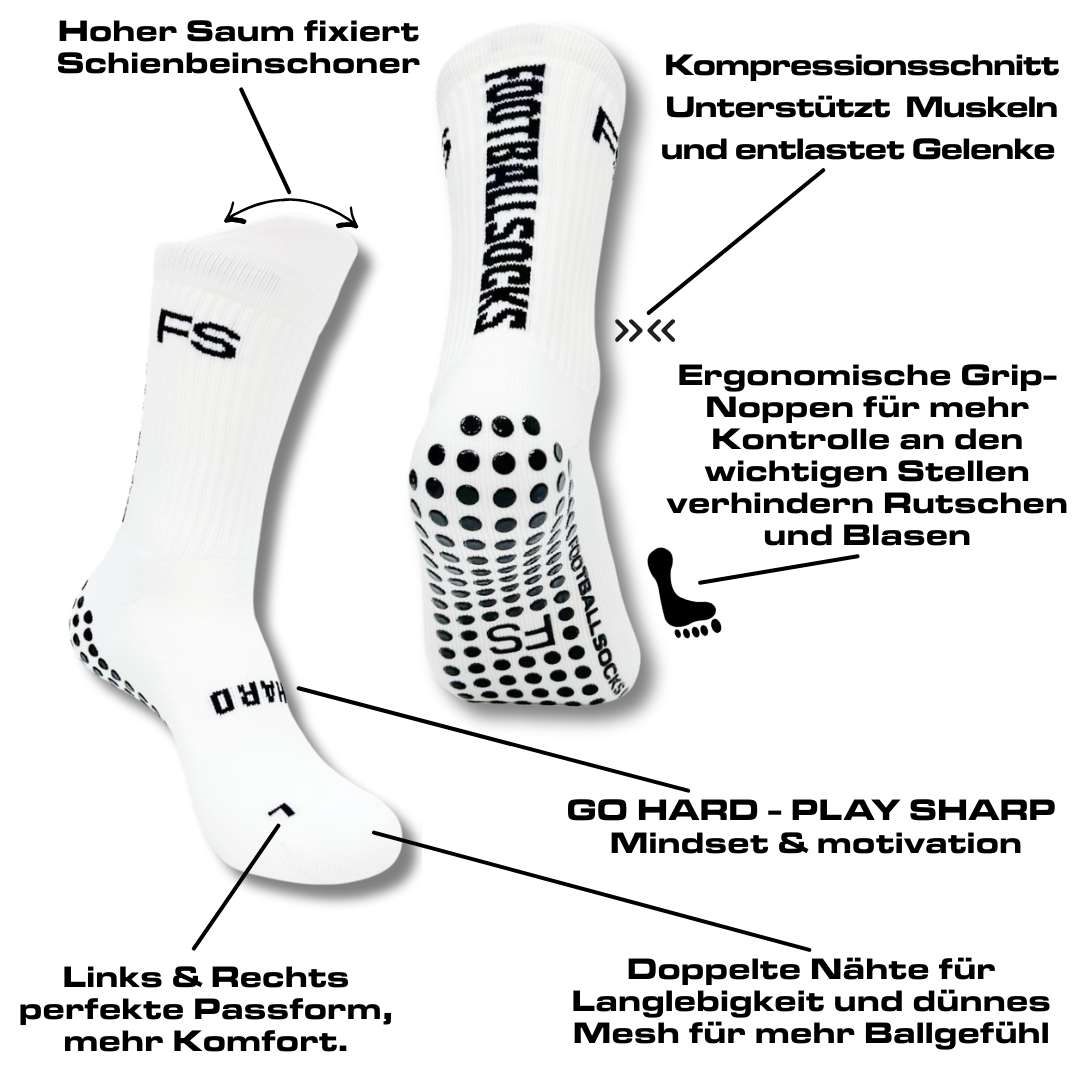
Modern football socks ensure that the foot remains stable in the shoe.
Grip studs reduce slipping and enable more direct power transfer.
The difference may seem small.
However, over a hundred sprints, changes of direction, and ball contacts, it adds up significantly.
Shin guards and accessories
If equipment constantly slips or bothers you, your mind is occupied with problems instead of the game.
The goal should always be:
Put it on, forget it, and play soccer.
The best players don't think about their equipment
They can fully concentrate on decisions, movements, and game situations.
The less energy you waste on trivialities, the more energy remains for the things that decide games.
Conclusion: Getting better is simpler than many think
The greatest progress doesn't come from secret tricks or miracle programs.
It comes from three simple principles:
1. Deliberately train new skills and regularly leave your comfort zone.
2. Take recovery as seriously as the training itself.
3. Create perfect fundamentals – from nutrition and sleep to suitable equipment.
Those who consistently improve these three areas will often make faster progress than players who simply train more.
Because in the end, it's not the one who does the most who wins.
But the one who does the right things.